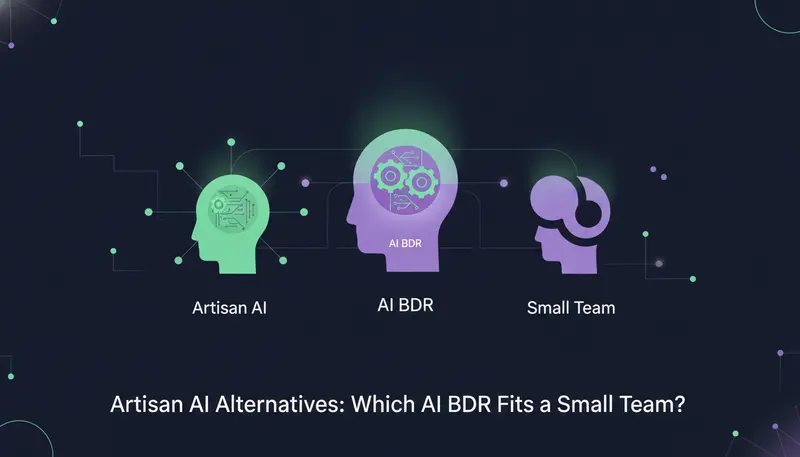
You're a founder or sales lead with a small team, and nobody has the hours to prospect every day. You've seen Artisan AI mentioned, and now you're weighing artisan ai alternatives before you commit any money. The short answer: the best AI BDR for a small team is the one whose messages you trust, whose price you can read, and which you can test for two weeks at no cost.
By the end of this guide you'll have a plain way to compare tools, a list of questions to ask any vendor, and a 14-day test plan.
Why do small teams look for Artisan AI alternatives?
Most small teams describe the same problems, and rarely in marketing language.
We don't have the time or people to prospect every day. Our outreach is generic and nobody replies. We're afraid an AI will send something wrong in our name. Our leads and follow-ups are spread across too many tools.
Those four sentences are the real brief. An AI BDR, short for business development rep, is software that takes on the daily work of prospecting: finding people, writing to them, following up and sorting what comes back.
Artisan AI is one of the products in that group. Teams compare it with others for ordinary reasons: control, price, channels and fit for their size.
What should a small team expect from an AI BDR?
The job has four parts. The tool should find the right people, write to them in your voice, follow up across channels, and deal with replies until a meeting is booked. If it only does one of those, you still own the rest.
Expect it to cut your daily work, not turn you into a full-time supervisor of software. A good tool saves you the repetitive hours and leaves you the decisions.
Also expect honesty about results. No vendor can promise replies, meetings or revenue, because those depend on your offer, your market and your list.
Here's the catch: a vendor that quotes results before it has seen your offer is guessing or selling. Ask what you can see in a real trial instead.
The rest of this guide assumes you want help, not a black box. That shapes how you should read the options.
What kinds of Artisan AI alternatives are there?
There are four broad kinds of tool, and they solve different problems.
- Fully autonomous AI BDR. Software that runs outreach with little or no human review.
- Approval-first AI SDR platform. The same jobs, but a person approves what goes out. ZOROSDR sits here.
- Database plus sequencer. You buy contact data and a sending tool, then write the messages and plan yourself.
- A person or an agency. You hire a rep or outsource the work. It's slower to start, and costs vary.
For a small team, the first two differ most. Here is how they typically compare.
| Autonomous AI BDR | Approval-first AI SDR | |
|---|---|---|
| Who sends the first message | The software decides | A person approves, edits or skips |
| Daily effort from you | Lowest | A short daily review |
| Risk of a wrong message in your name | Higher, with no check before sending | Lower, because you read it first |
| Best for | Teams happy to hand over control | Teams protecting their name and voice |
That table describes the two approaches in general, not any one product. For a named side-by-side, see our comparison of the best AI SDR tools for 2026, which covers pricing, features and fit.
Which questions should you ask any AI BDR before you pay?
A demo shows the best day of a product. These questions show the ordinary day.
Questions for every vendor
- Does a person approve every message before it sends, or can the tool send on its own?
- Where does it get its facts, and what does it do when it doesn't know something?
- How does it find people, and can I see why each one was chosen?
- Which channels run in one sequence, and which need a separate tool?
- Are messages sent from my own accounts or from shared servers?
- What happens when someone replies stop or unsubscribe?
- What is the full monthly price, including CRM and data?
- Can I test with my own list before paying, without a card?
Write the answers side by side for each tool on your shortlist. Gaps and vague replies tell you as much as the answers do.
The first question matters most for small teams, so it gets its own section.
Should an AI BDR send messages without a person approving them?
Autonomy sounds efficient. For a small team it's also where the risk sits. You have fewer prospects and fewer clients, so one wrong message costs more, and nobody has spare time to repair it.
ZOROSDR takes the opposite route. Every initial message lands in your inbox as a draft. Nothing goes out until a person approves, edits or skips it, and your edits are what get sent. Replies from leads also wait for a person.
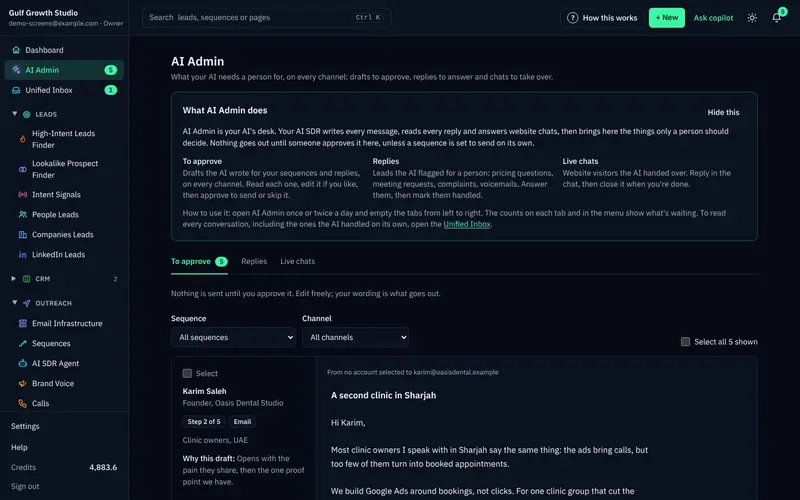
Two more rules back that up. The AI writes from your brand voice and the knowledge you gave it. If it doesn't know a fact, it says it will confirm rather than inventing an answer.
And opt-outs are handled at system level. A stop or unsubscribe request is caught before the AI even reads the reply, so nobody gets an accidental follow-up. You can read more on the guardrails page.
How does an AI BDR find the right people?
A tool that writes well to the wrong list still fails. So look closely at how it finds prospects.
ZOROSDR has two finders. The Lookalike Prospect Finder looks for more companies and people like your best customers. The High-Intent Leads Finder looks for decision makers at companies in a buying moment, using nine buying signals such as hiring, funding and new roles.
The lookalike search is the easier one to picture, so here is how it runs.
- 1Give it examplesadd up to five of your best customers and, if you like, up to three buyers who said yes.
- 2Read what they sharethe AI says what they have in common, such as industry, size, place, keywords and buyer roles.
- 3Review the companiesit finds companies like them and scores each one with a reason.
- 4Teach itpress More like this or Not a fit so the next search gets closer.
- 5Import the peopleuntick anyone you don't want, choose a sequence and press Import.
Cost control matters here too. Counting matches costs 1 credit, and ranking 100 companies costs 10 credits. Every paid step asks first and shows the most it can cost. Work emails and mobile numbers are found on demand and paid only when found.
Does a small team need more than email?
Usually, yes. People ignore an email and then reply to a LinkedIn message, or the other way round. And when each channel lives in its own tool, follow-ups slip.
ZOROSDR runs email, LinkedIn invites and messages, WhatsApp, Instagram DMs, website chat, SMS and AI phone calls in one sequence. Drafts to approve, replies to answer and live website chats all sit in one inbox. A built-in CRM comes with every plan at no extra cost.
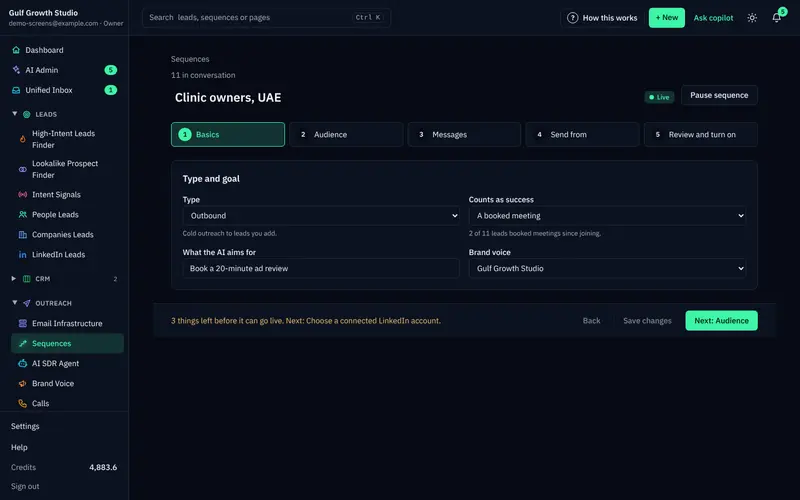
Delivery gets the same care. Messages go out through your own connected accounts, such as Gmail, Outlook and LinkedIn, so your outreach carries your own domain's reputation rather than a shared server's.
Built-in checks cover SPF, DKIM and DMARC alignment, with automated bounce handling. Sequences send within the lead's local working hours and respect safe daily platform limits.
What does an AI BDR cost a small team?
Price is where comparisons get muddy, because a monthly fee rarely tells the whole story. Ask what is included and what you would still pay for elsewhere.
ZOROSDR has three plans: Starter at $99 a month, Growth at $249 a month and Agency at $599 a month. The pricing page has the details.
ZOROSDR monthly plan prices (USD)
When you compare, add up the extras for every tool: contact data, a CRM, a separate inbox, a calling tool. With ZOROSDR the CRM is built in at no extra cost on every plan.
The cheaper way to judge a tool is to try it. Every new workspace starts with a free trial and sandbox credits.
That is enough to judge draft quality and lead quality before you spend anything.
How can you test an AI BDR in 14 days?
A trial only helps if you use it like real work. The next step is where most teams slip: they test on a made-up list, then wonder why the result tells them nothing.
- 1Pick one audiencechoose the customers you most want more of, so you can judge the fit of what comes back.
- 2Set up your voicelet the tool read your website, then review the offer, proof points and tone it drafts once.
- 3Build a short sequenceuse Suggest steps with AI, pick your channels, and leave at least 2 to 3 days between emails.
- 4Save, then turn it onpress Turn on sequence only after saving, and drafts start arriving in AI Admin.
- 5Read every draftapprove, edit or skip, and note how often you would change a draft.
- 6Review the leadscheck the reason given for each lead and decide whether they are people you would call.
Run the same plan on every tool you shortlist. Then compare drafts and leads, not feature lists.
What if you run outreach for clients?
Agency owners have a different version of the problem: running outreach for every client takes too many people. The same questions apply, with one more: can each client see their own work without seeing yours?
ZOROSDR gives agencies a client portal under their own brand and domain. Three client workspaces are included, and more cost $39 a month each. Billing, team, integrations and developer settings stay with the agency, clients never see a bill, and pausing a client stops everything without deleting anything.
The agencies page explains what clients can and can't do in the portal.
Where does ZOROSDR fit, and where doesn't it?
It fits when you want to review what goes out, when you want the AI to write from your own website and facts, and when you want email, LinkedIn, WhatsApp and calls in one sequence with one inbox.
It doesn't fit if you want no human involvement at all. A person approves every message, so you need a short review habit each day. We think that's the right trade for a small team, but it is a trade.
So shortlist two tools, run the same 14-day test on both, and keep the one whose drafts you would send with your name on them.
Frequently asked questions
What is an AI BDR?
An AI BDR is software that does the daily work of prospecting. It finds the right people, writes to them, follows up and sorts replies. How much a person stays involved depends on the product.
What should I compare when looking at Artisan AI alternatives?
Compare who approves messages, how the tool finds people, which channels run in one sequence, whether messages go from your own accounts, and the full monthly price. Then test each one on your own list.
Is there an AI BDR that doesn't send anything without my approval?
Yes. In ZOROSDR every initial message lands in your inbox as a draft, and nothing is sent until a person approves, edits or skips it. Replies from leads also wait for a person.
How much does ZOROSDR cost?
Starter is $99 a month, Growth is $249 a month and Agency is $599 a month. The built-in CRM is included on every plan.
Can I try ZOROSDR before I pay?
Yes. There is a 14-day free trial of every tool with no card needed. Every new workspace starts with 100 AI-written messages, 25 prospect-finding credits and 10 WhatsApp messages.
Summary
Choosing among artisan ai alternatives comes down to control, how a tool finds people, channel coverage and total cost. Ask the same questions of every vendor, and test on your own list before you pay.
If approval-first outreach sounds right for your team, start the 14-day free trial. If you'd rather talk it through, book a demo.