You don't have the time or people to prospect every day, and the outreach you do send gets few replies. So you're weighing an AI SDR vs hiring an SDR vs outsourcing to an outreach agency, and each one sounds sensible. A small team that wants to keep its own voice and control usually fits best with an AI SDR that a person approves; a hire fits a proven pitch and a manager with time; an agency fits a team that wants to stay out of the work.
By the end you'll have a side-by-side comparison, questions to ask each option, and a 14-day way to test the AI route before committing to anything bigger.
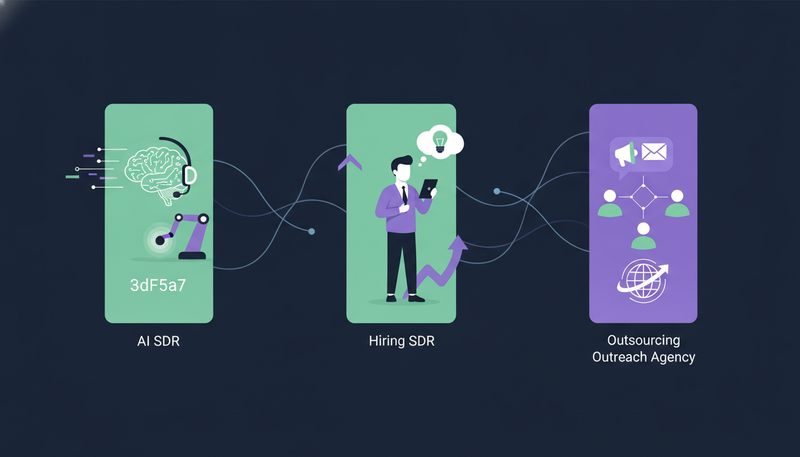
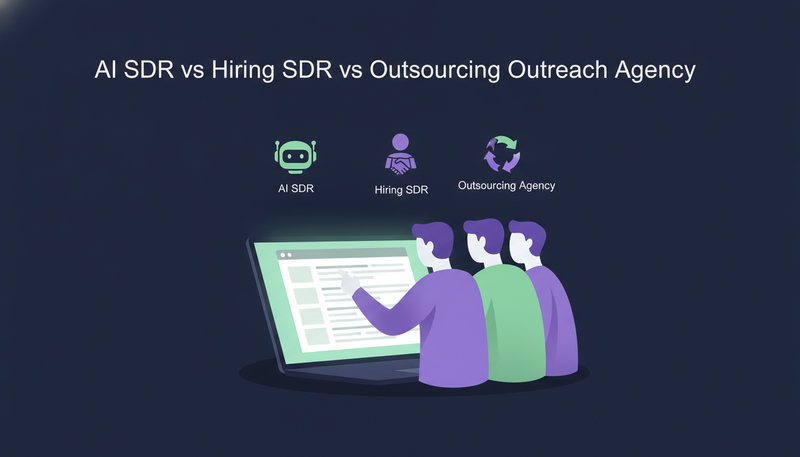
What is the difference between an AI SDR, a hired SDR and an outreach agency?
An SDR, or sales development rep, finds prospects, contacts them and works toward a first meeting. The three options differ in who does that work and who stays in control.
A hired SDR is a person on your payroll. An outreach agency is an outside team that runs outreach for you under a contract. An AI SDR is software that finds the people, drafts messages in your voice, follows up, sorts replies and helps book meetings.
ZOROSDR is the third kind. A person approves every message before it goes out, so it behaves like a team member who drafts and then waits for your yes. For the full definition, read what an AI SDR is, how it works, and its costs and risks.
| AI SDR | Hired SDR | |
|---|---|---|
| Who does the daily work | Software finds, drafts and follows up; you approve | One person, within their working hours |
| Whose voice | Yours, learned from your website and knowledge | Whatever they pick up and write |
| Control | Every message waits for approval | You manage them directly |
| Cost shape | A fixed monthly plan | A salary plus tools, which vary by market |
| Getting started | Set up, then review your voice once | Recruit, hire and train |
The pattern is simple. The AI route trades some human judgment for steady daily output, and a hire does the opposite.
When does hiring an SDR make sense for a small sales team?
Hiring makes sense when you already know what works. You can describe the ideal customer, the pitch and what a good first meeting looks like, and someone can coach the new person every week.
A person also brings what software doesn't: judgment on a tricky phone call, a feel for the room, and the ability to ask a colleague what to do. If your deals depend on that, a hire earns their place.
Here's the catch: one person covers one working day. Holidays, illness and the weeks spent recruiting and ramping up all leave gaps, and the person still needs email, LinkedIn, a CRM and a source of leads around them.
Signs you're ready to hire an SDR
- You can write your ideal customer and pitch in a few sentences
- Someone has time to coach and review work every week
- Your deals need live judgment on calls
- You can cover time off and gaps
- You have a plan for email, LinkedIn, a CRM and lead data
- You know what a good first meeting looks like
What does an outreach agency do, and where does it fall short?
An outreach agency runs prospecting for you. It finds leads, writes messages, sends them and reports back. For a team with nobody to spare, handing it over is attractive.
The risk is distance. The agency's writers learn your voice second-hand, and you may see results only in a report. Your name goes on messages you didn't read.
Before you sign with any agency, ask four things: who writes, who approves, which accounts send, and who owns the list if you leave.
Set next to an AI SDR, the differences come down to visibility and effort.
| AI SDR | Outreach agency | |
|---|---|---|
| Who writes the messages | Software in your voice, which you approve | The agency's writers, so ask how they learn your voice |
| Which accounts send | Your own connected accounts | Ask whether they use theirs or yours |
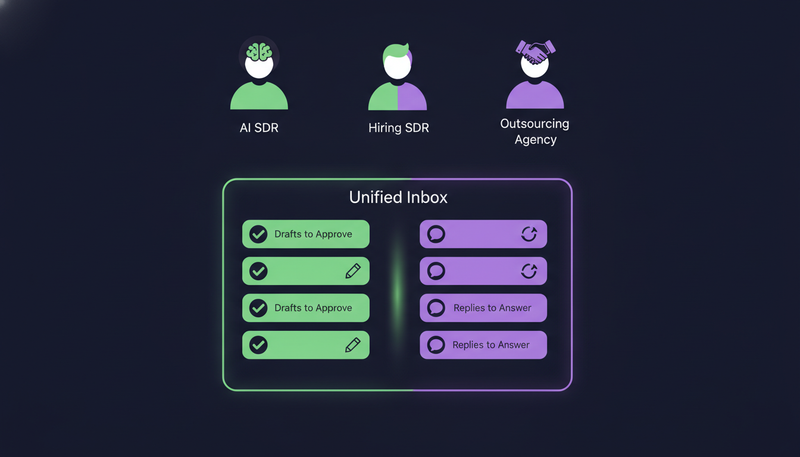
| Daily visibility | One inbox for drafts, replies and chats | Depends on the reports they send |
| Your effort | Review your voice once, then approve drafts | Briefings and review calls |
| Contract shape | Monthly plan, cancel any time | Ask for the terms in writing |
What does each option cost a small team?
Software has a fixed monthly price you can read. Hiring and agencies don't, so we won't guess at them. A hire costs a salary plus the tools around it, and an agency's fee depends on its contract. Ask for both in writing and add your own time.
ZOROSDR is sold as monthly plans in US dollars, cancel any time. Every plan includes every feature; the plans differ in seats, sending accounts and monthly allowances.
ZOROSDR plans, price per month in US dollars
Starter is built for a founder or a single rep: 1 seat, 2 sending accounts and 1,500 AI-written messages a month. Growth suits a team running several sequences, and Agency adds the client portal. A built-in CRM comes on every plan at no extra cost. See the full plan limits on the pricing page.
You can also test before you pay. Every new workspace starts with this:
None of this promises replies or meetings. It lets you judge lead quality and draft quality before you spend anything.
How does an AI SDR work day to day?
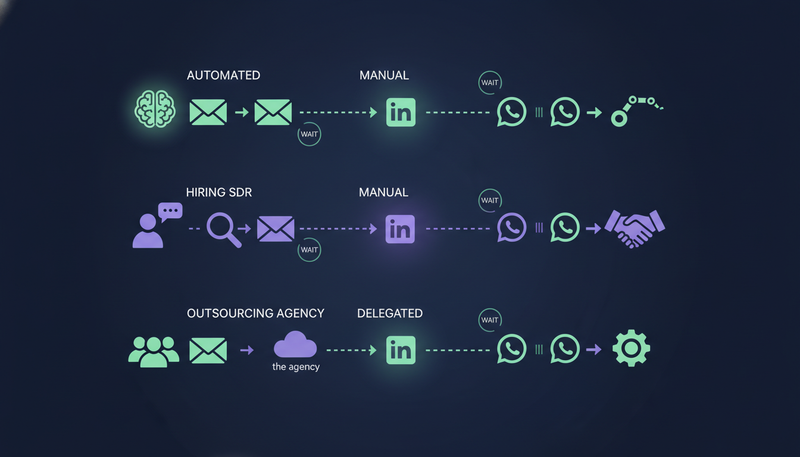
It follows four steps, and you stay in the loop at each one.
- 1Tell it who you sell toname your best customers or describe your ideal customer in a sentence, and it finds companies and people like them, ranked by fit with a reason.
- 2Let it learn your voiceit reads your website and drafts your offer, proof points and tone. You review it once, and from then on it states only facts you gave it.
- 3Approve every messageeach one lands in your inbox as a draft. Approve, edit or skip. Nothing is sent until a person says so.
- 4Answer the repliesa reply stops the sequence and is sorted as interested, a question, an objection, not now or stop. A suggested answer waits for you.
The next step is where most teams slip: they skim the drafts. Read them. The tool writes in your voice, but you are the one who knows the customer.
There are two ways to find people. The Lookalike Prospect Finder takes up to five of your best customers and finds more companies like them. The High-Intent Leads Finder looks for decision makers at companies in a buying moment, using nine signals such as hiring, funding and new in role.
Sequences can run across email, LinkedIn invites and messages, WhatsApp, Instagram DMs, website chat, SMS and AI calls, all in one workspace. They send within the lead's local working hours and stay inside safe daily platform limits.
Is an AI SDR safe to send in your name?
This is the fear we hear most: an AI sends something wrong in your name. Four safeguards answer it.
Approval comes first. Every first message lands as a draft, and nothing goes out until a person approves, edits or skips it. Replies to leads always wait for a person too.
Facts come second. The AI is locked into your brand voice and knowledge. If it doesn't know something, it says it will confirm rather than inventing an answer.
Opt-outs come third. System rules catch a stop or unsubscribe request before the AI even reads the reply.
Deliverability comes last. There are built-in checks for SPF, DKIM and DMARC alignment, plus automated bounce handling. Messages go out through your own connected accounts, such as Gmail, Outlook and LinkedIn, not shared servers. More on the guardrails: approval, facts only and opt-outs.
That covers safety. The last question is which option fits your team.
AI SDR vs hiring SDR vs outsourcing outreach agency: which fits a small sales team?
Choose the AI SDR if prospecting never gets done because nobody has time, you want your own voice on every message, and you want drafts, replies and chats in one inbox. Choose a hire if your pitch is proven and your deals need live judgment. Choose an agency if you want to stay out of the work and can accept less visibility.
Questions that decide it
- Can I write my pitch in a few lines?
- Who has time each week to coach, review or approve?
- Do I want to read every message that carries my name?
- Do my deals need live judgment on calls?
- Can I budget for a salary, an agency fee or a monthly plan?
- Does outreach need to keep running when someone is away?
The options aren't exclusive. Software can handle the daily prospecting while a person takes the conversations that come back. The AI SDR drafts; people do the selling.
How can you test an AI SDR in 14 days?
The trial is the cheapest way to settle the argument. Here is a simple plan.
- 1Sign upstart the free trial; it covers every tool and needs no card.
- 2Describe who you sell toname up to five of your best customers.
- 3Review your voicecheck the offer, proof points and tone it drafted from your website, and fix anything wrong.
- 4Approve a small batchread each draft, then approve, edit or skip.
- 5Judge on evidencelook at lead quality, draft quality and the time saved, then compare with what a hire or an agency would have to show you.
Decide on what you saw, not on what a sales page said.
Frequently asked questions
Is an AI SDR better than hiring an SDR?
Not always. An AI SDR fits teams that lack time for daily prospecting and want a fixed monthly cost and control over every message. A hire fits teams with a proven pitch, a coach and deals that need live judgment.
Can an AI SDR replace a person completely?
No. ZOROSDR drafts, follows up and sorts replies, but a person approves every message and answers the leads. It takes over the repeat work, not the conversations.
How much does an AI SDR cost per month?
ZOROSDR plans are $99 a month for Starter, $249 for Growth and $599 for Agency, billed monthly in US dollars. There is a 14-day free trial with no card needed.
Will an AI SDR send something wrong in my name?
Every first message is a draft that waits for a person's approval. The AI states only facts you gave it, and stop requests are caught before it reads the reply.
Summary
A hire gives you judgment, an agency gives you distance, and an AI SDR gives you daily output you still control. For a small team short on time, the AI route is the quickest to test. Start the free trial, or book a demo if you'd like to see it with someone from the team.