Cold calling laws and Do-Not-Call (DNC) lists are confusing enough, and now your team is asking whether an AI voice dialer can ring a prospect without a fine landing on your desk.
In the US, B2B calls to corporate numbers are generally exempt from the federal Do-Not-Call rules under the Telemarketing Sales Rule (TSR). Calling personal cell phones with autodialers or prerecorded AI voices is different: the Telephone Consumer Protection Act (TCPA) applies strictly, and consent usually comes first.
By the end you will know who each rule covers, how to check federal and state lists, where AI voices change things, and how to set up calling so a person stays in charge. This is general information, not legal advice.
B2B vs. B2C Cold Calling Rules Under TCPA and TSR
Two US rules do most of the work. Know which one covers your call before you dial.
What the TSR covers
The Telemarketing Sales Rule is the Federal Trade Commission's rule behind the National Do Not Call Registry. The registry exists to protect people at home, so calls to businesses are generally exempt from it.
There are limits. The ban on false or misleading claims still applies to B2B calls, and the exemption does not cover calls selling certain items, such as nondurable office or cleaning supplies. Sole traders and home offices answering on a personal number are a gray area, so treat them like consumers.
Where the TCPA bites
The Telephone Consumer Protection Act is a separate law, enforced by the FCC and through private lawsuits. It restricts autodialed calls, and calls that use artificial or prerecorded voices, to mobile numbers. It does not care much whether the phone is used for work.
Here's the catch: a prospect's mobile number is still a mobile number, even when you found it on a company profile. Calling it B2B does not remove the consent question.
| Corporate landline | Mobile or personal number | |
|---|---|---|
| Federal DNC registry | Generally not applicable to B2B calls | Applies to personal numbers that are registered |
| Autodialer or AI voice | Fewer federal limits, but check state rules | Consent usually needed first |
| False-claim rules | Apply | Apply |
| Safer approach | Honest opener, accurate caller ID, honor stop requests | Documented consent, or a person dialing by hand after a registry check |
Checking Federal and State Do-Not-Call Lists
The list check is dull, and skipping it is how many teams get into trouble. Consumer and personal numbers should be checked against the National Do Not Call Registry before you call, and checked again on a schedule rather than once.
State rules add another layer. Several states keep their own do-not-call lists or telemarketing laws, and some are stricter than the federal rules, including on calls to businesses. Look at the states where your prospects actually sit.
- 1Sort your listsplit corporate numbers from mobile and personal numbers, because they follow different rules.
- 2Check the federal registryscrub consumer and personal numbers before dialing, then repeat on a regular schedule.
- 3Check state listslook up the states your prospects are in, since state law can be stricter.
- 4Keep an internal listrecord everyone who tells you to stop and block them from every future list.
- 5Save the evidencekeep the date of each check and where each number came from.
Your own do-not-call list matters more than most teams think. Someone who asks to be left alone must stay left alone, even when they reappear in a fresh export next quarter.
Do AI Voice Dialers Count as Autodialers?
For consent purposes, assume yes. In 2024 the FCC said that AI-generated voices count as artificial voices under the TCPA. That puts AI voice calls to mobile numbers in the same bucket as prerecorded calls.
For telemarketing, that generally means prior express written consent. A number sitting in a database is not consent.
Why a human-sounding voice changes nothing
A synthetic voice that sounds natural is still a synthetic voice. The law looks at how the call is made, not at how good it sounds.
The next step is where most teams slip. They test an AI caller on a handful of corporate lines, see no trouble, then point it at a mixed list that includes mobile numbers. The risk sits in that mixed list.
Be honest about who is calling
Some places require callers to disclose that a voice is automated, and others may follow. Even where it is not required, pretending a synthetic voice is a person is a bad bet. Say who you are, which company you are from and why you are calling.
Calling Hours, Caller ID and Records
The TSR sets basic conduct rules that are easy to follow once they are written down. Calls are generally allowed between 8 am and 9 pm in the local time of the person you are calling.
You should also say who you are and which company you represent early in the call, and show accurate caller ID. A stop request has to be honored, not negotiated.
Records are your protection. If a complaint arrives, the dates of your list checks, the source of the number and any consent on file are what you will be asked for.
Need a simple routine? Run this list before every calling batch.
Pre-dial compliance checklist
- Number type checked: corporate, mobile or personal
- Federal registry and state lists checked, with the date saved
- Consent on file if the call is autodialed or uses an AI voice to a mobile number
- Calling hours set to the lead's local time, within 8 am to 9 pm
- Caller ID is accurate and leads to a working line
- Opener names you, your company and why you are calling
- Stop requests added to your internal list straight away
- A person has read the call script or brief
What About Calling Outside the US?
Everything above is about US rules. If you sell in the UAE, the wider GCC or other markets, the rules differ by country, and so do the rules on recording calls and handling personal data. Ask local counsel before you run a calling campaign in a new market.
The written side of outreach has its own rules. Our guide to CAN-SPAM, GDPR and CASL rules for cold email covers email, and staying GDPR compliant when scraping B2B leads covers where your lead data comes from.
How to Keep a Person in Control of AI Calls
ZOROSDR is an AI sales development platform that finds prospects and reaches them by email, LinkedIn, WhatsApp, Instagram, SMS, website chat and AI phone calls. Its design starts from one idea: a person decides what goes out.
By default, every message lands in AI Admin as a draft. An AI call card is a brief for your AI caller, not a message the lead reads. You read it, edit it if you want, and press "Approve and call". If you approve it outside calling hours, the call waits until they open.
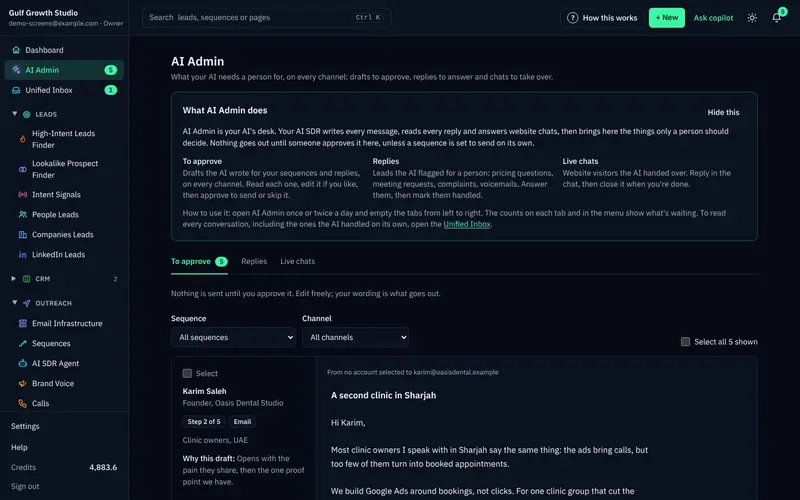
A few settings help with the habits above:
- Each account has a daily limit and sending or calling hours and days that you set.
- Sequences are built to send within the lead's local working hours.
- In a sequence's rules you can write lines such as "Only contact people who..." and "Never contact..." to screen outbound leads.
- A clear "stop" or "unsubscribe" is caught before any AI reads the reply, and the sequence stops for that person on every channel.
- Replies to leads always wait for a person.
The guardrails page explains approval, facts-only writing and opt-outs in more detail, and what happens when a lead replies or unsubscribes walks through the flow.
To be clear about the limit: the registry and state checks, and consent for calls to mobile numbers, belong in your own process with your legal adviser. Ask the team in a demo what the platform does and does not cover.
You can test the approach without risk. Every new workspace starts with sandbox credits.
Want to see the approval flow for calls yourself?
Cold Calling Laws and Do-Not-Call (DNC) Lists Explained: Common Mistakes
Most problems come from a short list of habits. None of them needs a lawyer to spot.
Treating B2B as a free pass
The exemption is real but narrow. False-claim rules still apply, some product categories are excluded, and mobile numbers bring the TCPA into the picture.
Mixing number types in one batch
A list with landlines and mobiles needs different handling for each. Split it first, then decide how each group gets contacted.
Stopping on one channel only
If a lead tells you to stop by email, a call a week later is a problem. Treat a stop as a stop everywhere, which is how your tools should behave too.
Keeping no records
Without dates and sources you cannot show you did the work. Save them as you go.
For the wider picture of running outreach across several channels, see the channels page.
Frequently asked questions
Do B2B cold calls need to be checked against the National Do Not Call Registry?
Generally no for calls to corporate numbers, because the registry protects consumers. Check any personal or mobile number, and check state rules, which can be stricter.
Can I use an AI voice for cold calls in the US?
In 2024 the FCC said AI-generated voices count as artificial voices under the TCPA. Calls to mobile numbers with such voices usually need prior consent, so get legal advice before you start.
Does a business mobile number count as a business line?
Not for TCPA purposes. Autodialed and prerecorded or AI-voice calls to mobile numbers can be restricted whether the phone is used for work or not.
What should I do when someone says stop?
Stop contacting them straight away and add them to your internal do-not-call list. In ZOROSDR, a clear stop request is caught before any AI reads it, and the sequence stops on every channel.
Summary
B2B calls to corporate numbers are generally outside the federal DNC rules, but mobile numbers, autodialers and AI voices bring the TCPA into play. Check federal and state lists, keep your own stop list, respect calling hours and keep records.
To see how a person stays in control of every call brief, start the 14-day free trial or book a demo.