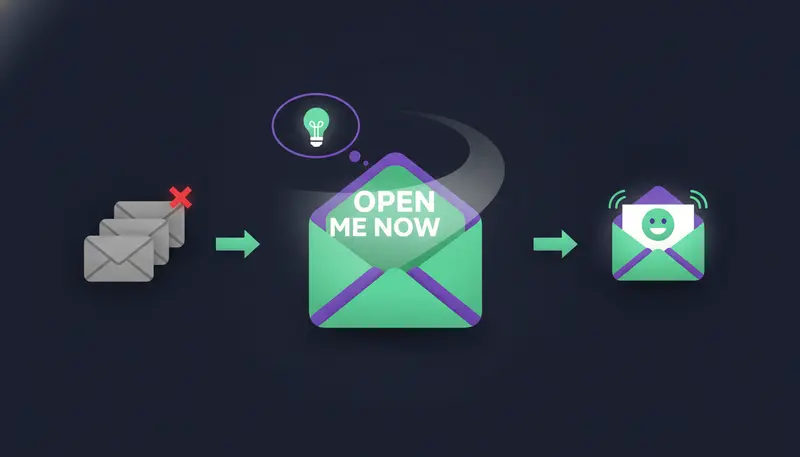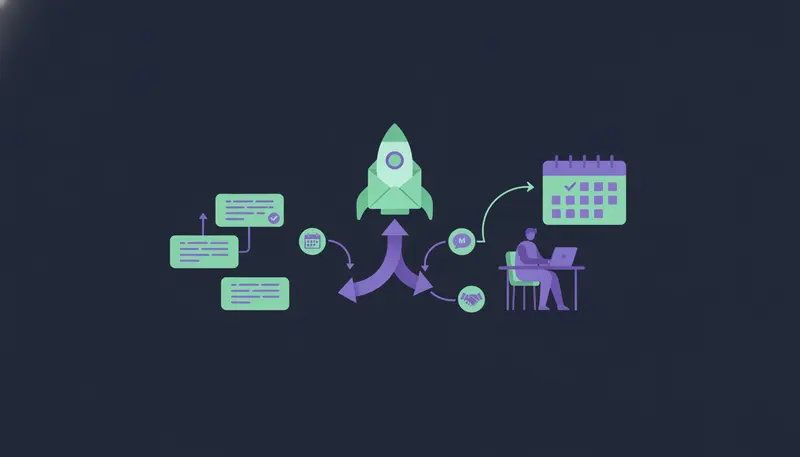
You sent a cold email, heard nothing, and now you're not sure whether a second message is persistence or pestering. That doubt is why many sequences stop after one email, or drag on for ten and annoy everyone. If you want cold email follow-up sequences that book meetings, keep them short, spaced out and varied.
The short answer: send a 4-touch sequence spread over 14 to 18 days. Each follow-up should bring a new angle, such as a case study, a useful resource or a re-prioritization of why this matters now, rather than a nudge that adds nothing new to the reader's day.
By the end you'll have the cadence, the wait days, what each email should say and a checklist to run before you launch.
Optimal Cold Email Cadence: Number of Touches and Wait Days
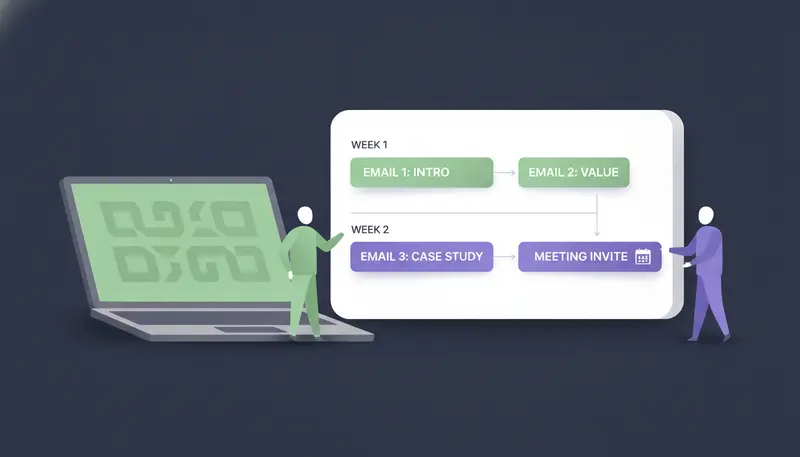
Four touches is a sound default: your first email plus three follow-ups. That gives a lead enough chances to notice you without turning your name into background noise.
The wait days widen as you go. Early follow-ups come quickly because the first email is still fresh. Later ones come further apart, like a busy person with something to say, not a timer.
Here is the cadence and what each touch is for:
- 1Day 1, the core emailsay who you are, why you are writing to this person and ask one soft question.
- 2Day 4, the proofadd a short case study or a specific example so the lead has a reason to believe you.
- 3Day 9, the resourceshare something useful, such as a checklist, a guide or a relevant page, with a very light ask.
- 4Day 14 to 18, the re-prioritizationsay why now may be a better moment, then offer an easy way in or an easy way out.
That is four emails with gaps of about 3, 5, then 5 to 9 days. Use the shorter end when your offer is time-sensitive and the longer end when your buyers are senior.
Past the fourth message, each new email mostly repeats the last. You also raise the odds of annoying someone who was never going to answer, and of a spam complaint that hurts the mailbox you need for other leads.
Here's the catch: more touches only help if each one says something different. If you only have three honest angles, send three.
Email 1 (Day 1): The Core Value & Relevance Hook
The first email carries the whole sequence. If it is generic, three follow-ups of the same quality won't rescue it.
Keep it to a few short lines. Open with something true about the lead's world, name one pain you can help with, add one line on how you help, and end with a soft question like 'Is this something your team is looking at?' rather than 'Can I have 30 minutes on Thursday?'
Your subject line only has to get the email opened, and how to write cold email subject lines that get opened covers that step.
Hold something back on purpose: a proof point for Email 2, a resource for Email 3. Each later message then has a reason to exist.
Before Email 1 goes out, check it against this list:
Email 1 check
- It names something specific to the lead or their company
- It states one pain, not three
- It says how you help in one line
- It ends with one soft question
- It contains only facts you can stand behind
- It reads easily on a phone
Email 2 (Day 4): Add Proof With a Case Study
Email 2 answers the quiet question every cold email raises: why should I believe you? Answer it with a short example, such as a customer in a similar situation, what they were stuck on and what changed.
Use only a real story and only facts you can confirm. If you have no case study you may share, describe honestly how your process works instead. Never invent a customer or a number to fill the gap.
Keep it to three or four lines. Mention Email 1 in a single clause so it reads as a continuation, then put the proof first and the question last.
Email 3 (Day 9): Share a Resource, Not a Request
By now the lead has seen your name twice. Email 3 gives something instead of asking for something: a short guide, a checklist, a page on your website, a template or a two-line tip from your own work.
Match the resource to the pain you named in Email 1. An unrelated resource feels like content marketing, and the lead can tell.
End with a lighter ask than before, or none at all. 'Happy to send the longer version if it's useful' is enough.
This is also a good point to add another channel, such as a LinkedIn invite, so the lead sees you somewhere besides their inbox.
Email 4 (Day 14 to 18): Re-prioritize and Close the Loop
The last email changes the question. Instead of 'Would you like this?', ask 'Is this the right time?' Re-prioritization means admitting your message may rank below other things on their desk, then saying plainly why it could matter now: a goal, a hire, a launch or a change in their market, anything you know to be true.
Then make it easy to answer in any direction: 'If this isn't a priority right now, tell me and I'll leave it, or point me to the right person.' A no, a not now and a referral all tell you something, and closing the loop politely keeps the door open.
| Nudge that adds nothing | Follow-up with a new angle | |
|---|---|---|
| Opening line | Refers to the last email and asks for a reply | Opens with something the lead can use |
| What the reader gets | Nothing new | A proof point, a resource or a reason to act now |
| The ask | Any thoughts? | One small, specific question |
| How it reads | Like automated mail | Like a person with something to say |
| Easy to answer | Not really | Yes, and 'not now' is a valid answer |
None of these rows promises a reply, and no cadence can. A better follow-up simply makes a reply easy and worthwhile for someone who is willing.
How to Write Cold Email Follow-Up Sequences That Book Meetings Without Sounding Generic
Write each follow-up from a brief, not from a template. A brief is one line telling the email what to do, for example 'one pain from their world, one line on how we help, a soft question.' Each message is then written fresh for the lead.
If replies stay low, read five messaging mistakes behind silent cold emails before you change the cadence. The cause is often the message, not the number of touches.
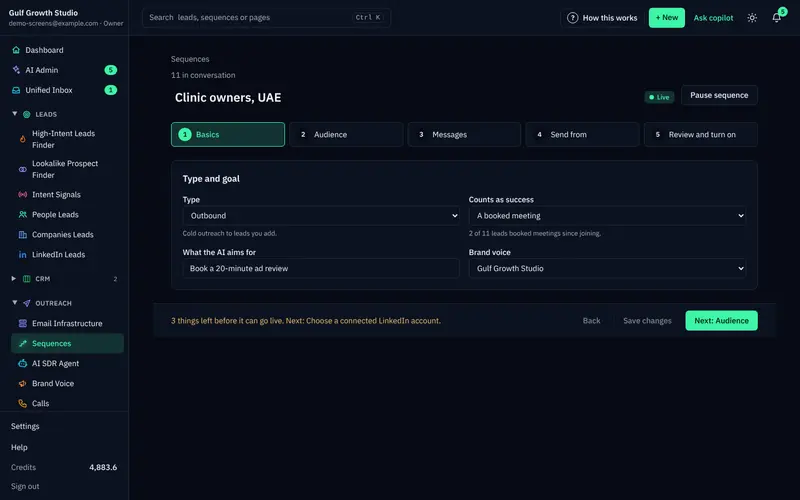
In ZOROSDR you build this as a sequence. Each step has a wait in days and a brief for the AI, and 'Add follow-ups' adds up to 5 email or LinkedIn follow-ups at a tight, standard or relaxed pace.
The AI writes in your voice from your website and the knowledge you give it, and states no fact you didn't provide. Every first message lands in your inbox as a draft, and nothing goes out until a person approves, edits or skips it.
How Many Emails a Day Can a Four-Touch Sequence Send?
Follow-ups multiply volume. A list of 50 leads on a four-touch sequence means up to 200 emails over about two weeks, so your daily limits matter as much as your copy.
Every plan sends at most 100 emails a day per mailbox and 50 LinkedIn actions a day per account, to keep accounts safe. Messages go from your own connected accounts, not a shared server, and within each lead's working hours.
Leave 'Warm up gradually' on for new email and LinkedIn accounts, because a brand-new inbox that sends a lot from day one gets flagged. Our guide on how many cold emails to send per day, per inbox goes deeper.
Should You Add LinkedIn or WhatsApp Between the Emails?
A LinkedIn invite between Email 2 and Email 3 gives the lead a second place to see you. A LinkedIn message after an invite waits until they accept, for up to 21 days.
WhatsApp and SMS go only to leads who agreed to them, and a WhatsApp Business number needs an approved template for the first message. See the channels ZOROSDR covers for the full list.
Whatever you add, one rule holds:
Frequently asked questions
How many follow-ups should I send in a cold email sequence?
Three follow-ups after your first email, so four touches in total, spread over 14 to 18 days. If you have no new angle for the fourth, send fewer rather than repeating yourself.
How many days should I wait between cold email follow-ups?
About 3 days after Email 1, 5 days after Email 2 and 5 to 9 days after Email 3. The early gaps are shorter because the first email is still fresh.
What should a cold email follow-up say?
Something new each time: a short case study in Email 2, a useful resource in Email 3, and a re-prioritization with an easy way to say not now in Email 4. Keep each one to a few lines.
Can AI write my follow-ups without sending something wrong?
In ZOROSDR the AI writes from your brand voice and knowledge and states no fact you didn't give it. Every first message lands as a draft that a person approves, edits or skips, and replies always wait for a person.
Summary
A good cold email sequence is four touches over 14 to 18 days with a new angle each time: the core value, proof, a resource, then a re-prioritization. Keep it in your own voice, inside safe sending limits, and stop when someone replies. To try it, start the 14-day free trial or book a demo.