Your cold emails are decent, but nobody opens them. How to write cold email subject lines that get opened comes down to one rule: keep them one to four words in lowercase sentence case, make them look like a note from a colleague, and leave out punctuation, emojis and promotional claims. Everything below is how to apply it.
By the end you will have the rules, 15 formulas to adapt, a five-step process for writing your own and a checklist to run before you send.
Rules for High-Open Cold Email Subject Lines
We don't quote open-rate percentages here, because we have no study we can point you to. These are the rules B2B senders rely on most, so treat them as a starting point and check them against your own results.
Keep it to one to four words
A subject line has one job: get the email opened. Short lines are read whole, while long ones are often cut off in a phone inbox. If a word doesn't name the topic, cut it.
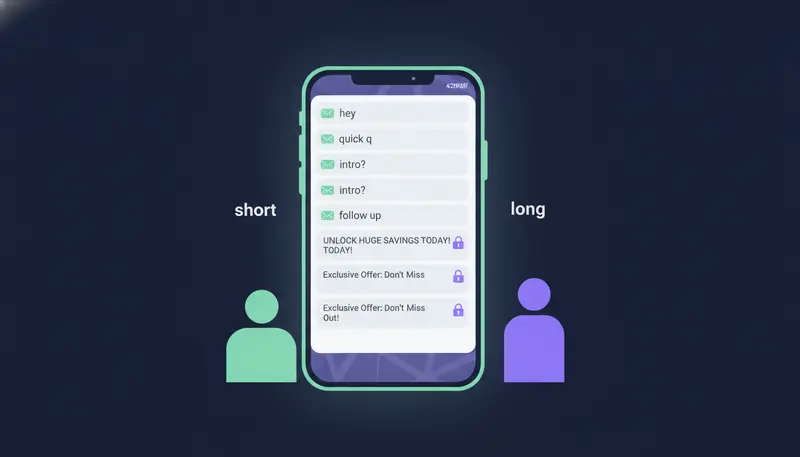
Use lowercase sentence case
Title Case and ALL CAPS look like marketing. Lowercase looks like something a person typed between meetings. Keep names and brands as they are, and lowercase the rest.
Write it like an internal email
Colleagues write friday handover or budget review. They don't write Exclusive offer inside. Name a plain topic the reader would recognise from their own week, and your line sits naturally among the rest of their inbox.
Leave out punctuation, emojis and promotional claims
No exclamation marks, no emojis, no free, guaranteed or 10x. They make the email look like a mailing list before it is opened. A claim in a subject line is also a promise the email then has to keep.
| Reads like a colleague | Reads like an ad | |
|---|---|---|
| Length | one to four words | a full sentence or more |
| Case | lowercase | Title Case or ALL CAPS |
| Punctuation | none | exclamation marks, colons, emojis |
| Content | a topic the reader owns | an offer or a promise |
| First reaction | someone I might know | a mailing list |
Here's the catch: a subject line only works if the email reaches the inbox. If your messages land in spam, nobody sees it. If you suspect that, start with this diagnostic checklist for cold emails going to spam.
15 Subject Line Formulas by Angle
A formula is a starting shape, not a script. Swap in a real topic from the reader's world and keep it to four words or fewer. Every example is lowercase with no punctuation.
Internal angle: sounds like a colleague
These name something the reader owns at work. They only work when the topic is true for their role.
- The team topic:
outbound capacity. Names the work the reader is responsible for. - The process:
lead handover. Fits a head of sales or a sales manager. - The tool:
inbox setup. Suits an ops-minded founder. - The timeframe:
q3 pipeline. Ties to planning cycles.
Question angle: one short thought
Ask something the reader can answer in their head. Skip the question mark.
- Who owns it:
who owns outbound. - Who handles it:
who handles replies. - Is it in place:
using whatsapp yet. - The time question:
time to prospect.
Trigger angle: a real event
Use a real event, and only one you have actually confirmed. If you haven't seen it, don't refer to it.
- New hire:
new sales hire. Only if their team has announced one. - Launch:
your product launch. - New market:
dubai expansion. - Growth:
new client onboarding. Useful for agency owners.
Referral and relevance angle
Use these when a real person or a real shared context makes the email relevant.
- Mutual contact:
intro from sara. Only if Sara really suggested you write. - Same industry:
saas outbound. - Same region:
gcc sales teams.
How to Write Cold Email Subject Lines That Get Opened, Step by Step
The process matters more than any single formula. Here is the one to repeat for every sequence.
- 1Name the reader's topicpick one thing they own at work, such as outbound, handovers or inbox setup, so the line is about them.
- 2Cut to four words or fewerremove every word that doesn't name the topic.
- 3Strip it downlowercase it and remove punctuation, emojis and claims.
- 4Check it against the emailthe first line of the body should pick up what the subject said.
- 5Send a small batchcompare two versions before you change everything.
The next step is where most teams slip: matching the email to the subject. A line that says lead handover, followed by a paragraph about your company history, loses trust fast. Read the pair together before you send.
For bodies to pair with these lines, see high-converting cold email templates for B2B SaaS and prompts for personalized cold emails.

Match the Subject to the Email, Then Approve It
In ZOROSDR, every draft lands in AI Admin before anything goes out. You read the lead's details and "Why this draft", edit the subject or text right in the card, then press "Approve and send".
If the subject is off, press "Ask for a rewrite" and say what to change, for example "shorter, no punctuation". A draft can be rewritten up to 5 times. After that, edit it yourself.
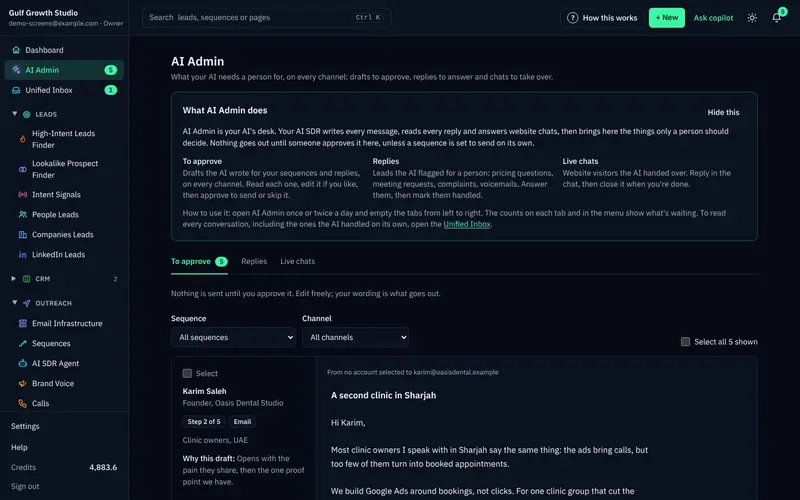
You can also set the standard once. Each sequence step has a brief for the AI, and you can write the subject rule into it: one to four words, lowercase, no punctuation. The AI writes in your voice from your own website and knowledge, and states no fact you didn't give it.
The AI also avoids words that make a message read as machine-written. A draft that uses them is written again and marked "Check before sending". For more on why a person reviews each message, read why a person checks every message.
Subject Line Mistakes That Cost You Opens
Most subject line problems are habits, not bad luck. These are the ones to look for first.
- Faking a thread.
re:orfwd:on a first email says something untrue, and it costs trust the moment the email is opened. - Curiosity bait. A vague line that the email doesn't pay off teaches people to ignore you.
- Name-only personalisation. A first name is not relevance. A topic they own does more, and if a lead has no first name, write around it.
- Promotional words. Anything that sounds like an offer pulls the line away from the colleague style.
- An unverified trigger. If you can't point to the event, leave it out.
How to Test Subject Lines Without Guessing
Opens are a rough signal, so judge a subject line by replies as well. Test small and change one thing at a time.
Pick one audience and write two lines that differ in one way, such as a topic versus a question. Send each to a similar group, then read what comes back before you roll one out. A mailbox in ZOROSDR sends at most 100 emails a day, and new email accounts warm up gradually over 3 weeks, so small tests suit the setup anyway.
Every new workspace starts with room to try this at no cost:
Run this list before every batch:
Before you press send
- The line is one to four words
- It is lowercase, apart from names and brands
- It has no punctuation, emojis or claims
- It names a topic the reader really owns
- Any trigger in it is one you have confirmed
- The first line of the email picks up the subject
- It is not a fake reply or forward
- You know which one thing you are testing
Frequently asked questions
How long should a cold email subject line be?
One to four words. Short lines are read whole, and every extra word is another reason to skip. If a word doesn't name the topic, cut it.
Should cold email subject lines be lowercase?
Yes, in plain lowercase sentence case. It looks like a quick note from a colleague rather than a campaign. Keep names and brands as they are.
Can I use the prospect's name or company in the subject line?
You can, but a name alone is not relevance. A topic they own does more of the work. If you have no first name for a lead, write the line without one.
Are emojis or exclamation marks ever worth using?
Not in cold B2B email. They make the message look like a mass mailing before it is opened. Plain words, no punctuation, are the safer choice.
How many subject lines should I test at once?
Two per audience, differing in one way. That way you know what caused any difference. Read replies as well as opens before you decide.
Summary
Keep subject lines to one to four words, in lowercase, with no punctuation, emojis or claims, and make them sound like a colleague naming a real topic. Use the 15 formulas as shapes, check each line against the email inside, and test two versions on a small batch. When you are ready to try it, start the 14-day free trial.