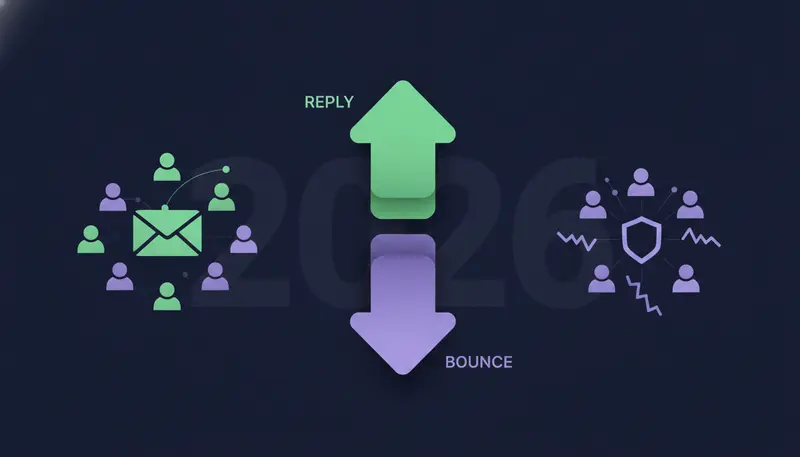
You sent a few hundred cold emails, got a handful of replies, and now you can't tell whether that's good or bad. These B2B cold email benchmarks for 2026 give you the short answer: healthy bounce rates stay under 2%, total reply rates average 3% to 6%, positive reply rates range from 1% to 2.5%, and top-decile targeted campaigns achieve 5% or more positive replies. Treat them as working ranges, not promises.
By the end you'll know where your numbers stand, why open rate stopped being a useful metric, and what to fix first.
B2B Cold Email Benchmarks for 2026 (Reply Rates, Bounce Rates & Conversions)
Here is how the ranges break down. Read each row on its own, because a campaign can be strong on one metric and weak on another.
| Metric | Poor | Average | Top 10% |
|---|---|---|---|
| Bounce rate | 2% or higher | Under 2% | Under 2%, held there with list and domain checks |
| Total reply rate | Below 3% | 3% to 6% | Above the average range |
| Positive reply rate | Below 1% | 1% to 2.5% | 5% or more |
Between 2.5% and 5% positive replies sits above average but short of the top group. Most good campaigns live in that middle.
One honest caveat. These are rules of thumb for judging a campaign, not ZOROSDR results and not a guarantee. Your market, your list and your offer all move them. In the UAE and the wider GCC, target lists are often small, so a few replies can swing a percentage a lot. Wait for enough sends before you decide.
How each metric is counted
Bounce rate is the share of emails that could not be delivered. Total reply rate is the share of leads who answered in any way, including 'not now' and 'stop'. Positive reply rate is the share who showed interest or asked a question that moves the conversation forward.
In ZOROSDR every reply is read and sorted as interested, a question, an objection, not now or stop. That makes the positive count easy to pull apart from the rest.
Why Open Rate Is No Longer a Reliable Metric
Open rate used to be the first number people checked. Today it is a weak signal. An open is counted when a tiny hidden image loads, and that can happen without a person reading anything. Some mail apps fetch images in advance. Others block them, so real reads go uncounted.
The number can be too high or too low, and you can't tell which. Here's the catch: a team that chases opens ends up writing subject lines that win the click and lose the reply.
| Open rate | Reply rate | |
|---|---|---|
| What it measures | A hidden image loaded | A person wrote back |
| Can it be wrong? | Yes, in both directions | Rarely, apart from auto-replies |
| What it tells you | Little about real interest | Whether your message and targeting landed |
| Best use | A rough hint that something broke | The main score for a campaign |
If you still look at opens, use them to spot a sudden drop after you change something. Don't use them to declare a winner. A subject line is only good if the right people reply to the email behind it.
What Is a Good Bounce Rate for B2B Cold Email?
Under 2% is healthy. Above it, stop and fix the list or the domain before you write another email.
A bounce tells mail providers you are sending to addresses you haven't checked. Do that often and your good emails start landing in spam too. The usual causes are old lists, guessed addresses and a sending domain that isn't set up properly.
Before any email goes out
- Check every address before it enters a sequence
- Confirm SPF, DKIM and DMARC are set up on the sending domain
- Remove bounced addresses straight away and don't retry them
- Warm up new inboxes gradually instead of sending full volume on day one
- Stay inside safe daily limits for each mailbox
- Send from your own connected mailbox, not a shared server
- Re-check older contacts before you reuse a list
A low bounce rate doesn't prove your emails reach the inbox. A message that lands in spam isn't a bounce. It just never gets read. If replies are low while bounces look fine, work through why your cold emails are going to spam.
ZOROSDR builds these protections in: address checks, domain health checks for SPF, DKIM and DMARC, bounce handling and daily limits. Messages go out from your own connected accounts, so your outreach inherits your own domain's reputation.
Total Reply Rate vs Positive Reply Rate: Which One Matters?
Both, but for different reasons. A 5% total reply rate sounds great until you read the replies. If half say 'stop' or 'not now', the campaign is doing less than the number suggests.
| Total reply rate | Positive reply rate | |
|---|---|---|
| What counts | Any reply, including objections and opt-outs | Interest, or a question that moves things on |
| Average range | 3% to 6% | 1% to 2.5% |
| What it tells you | Whether people noticed and answered | Whether the right people want what you sell |
| Weak spot | Inflated by 'stop' and 'not now' | Small numbers need more sends to read |
Total replies mostly reflect targeting and delivery. Positive replies reflect fit and offer. If total replies are healthy but positive ones are low, your emails are reaching people, just not buyers.
What Do Top 10% Cold Email Campaigns Do Differently?
Top-decile campaigns reach 5% or more positive replies. There is no single trick behind that. It comes from a tight list, a message written for one person, and follow-ups that arrive at sensible times.
Targeting does most of the work. A well-written email to the wrong company gets nowhere, while a plain one to the right company often gets an answer. If you haven't defined who you sell to, start with this guide to building an ideal customer profile for outbound.

The next step is where most teams slip: they widen the list to hit volume. Here is the pattern strong campaigns tend to share.
- 1Narrow the listPick one role in one kind of company. A small, well-matched list beats a large, vague one.
- 2Find lookalikes and buying momentsLook for companies like your best customers, and people at companies in a buying moment. ZOROSDR's Lookalike Prospect Finder and High-Intent Leads Finder do both.
- 3Write for one personOne pain from their world, one line on how you help, a soft question. State only facts you can back up.
- 4Follow up across channelsAdd follow-ups by email and LinkedIn with waits between them, so each step adds something new. See cold email follow-up sequences that book meetings.
- 5Send in their working hoursA message that arrives during the lead's working day is more likely to be read.
- 6Answer replies quicklyA warm reply cools fast, so read and respond the same day.
Approval matters here too. In ZOROSDR every first message lands as a draft that a person approves, edits or skips, and the AI is locked to your brand voice and the facts you gave it. That keeps generic or wrong-in-your-name emails off your list. See the guardrails for how it works.
How to Read Your Numbers in the Right Order
Work from the top of the table down. Each metric points at a different fix.
Bounce rate above 2%. Fix the list and the domain first. Nothing else matters if mail isn't being delivered cleanly.
Total reply rate below 3%. Look at targeting and timing. Are you writing to people who have the problem you solve? Are messages arriving in their working hours? Check the size of the list too, because a very small one can look worse than it is.
Positive replies below 1% while total replies look fine. The offer or the ask is off. People answer, but not with interest. Shorten the message, name one pain and ask a soft question instead of pushing for a meeting.
Positive replies between 2.5% and 5%. You are above average. Keep the list tight and look for the one step in the sequence that gets the most answers.
From Replies to Booked Meetings: Tracking Conversions
Reply rates are the middle of the story. What you actually want is meetings. Track the full chain: sent, replied, positive, meeting booked.
We won't put a single benchmark on how many positive replies turn into meetings. It depends too much on your offer, who answers and how quickly you respond. Measure your own and watch the trend.
In ZOROSDR a reply stops the sequence and a suggested answer waits in the inbox for a person to approve. Replies always wait for a person, so nothing goes out in your name unread. The Analytics page shows people reached, engaged and meetings booked, by sequence and channel.
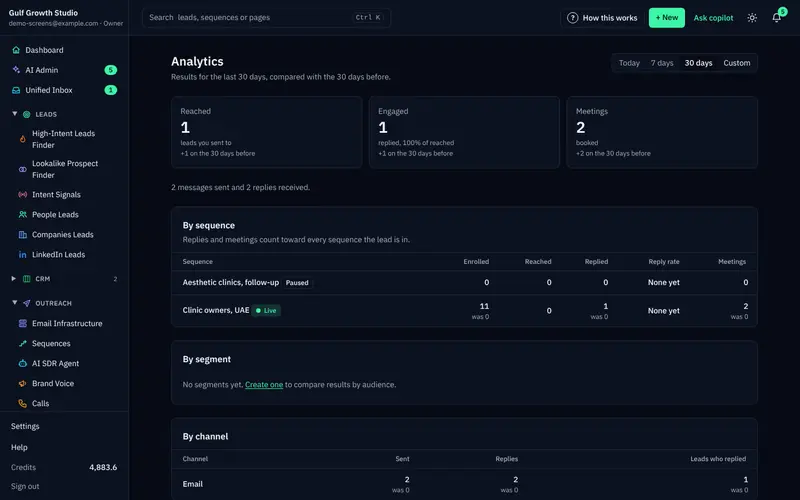
Compare by sequence and channel rather than one account-wide average. A strong LinkedIn and email sequence can hide a weak email-only one.
Track for every campaign
- Bounce rate for each mailbox
- Total reply rate for each sequence
- Positive reply rate for each sequence
- Opt-outs, kept out of the positive count
- Meetings booked from positive replies
- The one change you made since the last campaign
Frequently asked questions
What is a good reply rate for B2B cold email?
A total reply rate of 3% to 6% is the average range. Positive replies, meaning interest or a useful question, usually run 1% to 2.5%. Top targeted campaigns reach 5% or more positive replies.
What bounce rate is acceptable for cold email?
Keep it under 2%. Above that, check your addresses, your domain setup (SPF, DKIM and DMARC) and your sending volume before you send more.
Is open rate still worth tracking?
Only as a rough hint. Opens can be counted when nobody read the email and missed when someone did. Use reply rate and positive reply rate to judge a campaign.
How many contacts do I need before I trust my reply rate?
We won't give a fixed number. The smaller the list, the more a few replies swing the percentage, so wait until enough contacts have been through the whole sequence before comparing results.
Summary
A healthy B2B cold email campaign keeps bounces under 2%, sees 3% to 6% total replies and 1% to 2.5% positive replies, and the best targeted ones reach 5% or more positive replies. Judge on replies, not opens, and fix problems in order: list and domain first, then targeting, then the offer.
To test this on your own list, start the 14-day free trial. Every new workspace gets 100 AI-written messages, 25 prospect-finding credits and 10 WhatsApp messages to try, with no card needed.