You pay for tools, inboxes, data and people to run cold outbound, but when someone asks how to calculate cold outbound ROI and customer acquisition cost (CAC), all you have is a guess. Here is the short answer.
Outbound CAC equals total software, domain and inbox costs, data credits and SDR or agency labor, divided by the new customers closed. Compare that figure against customer lifetime value (LTV): if LTV is several times CAC, the channel is paying its way.
By the end you will have the formula, a worked example from 1,000 prospects to closed deals, and a plain list of what moves the number.
The Exact Formula for Outbound CAC and Pipeline ROI
Outbound CAC is everything you spent on cold outreach in a period, divided by the customers that outreach produced. The formula is simple. The cost side is where teams undercount.
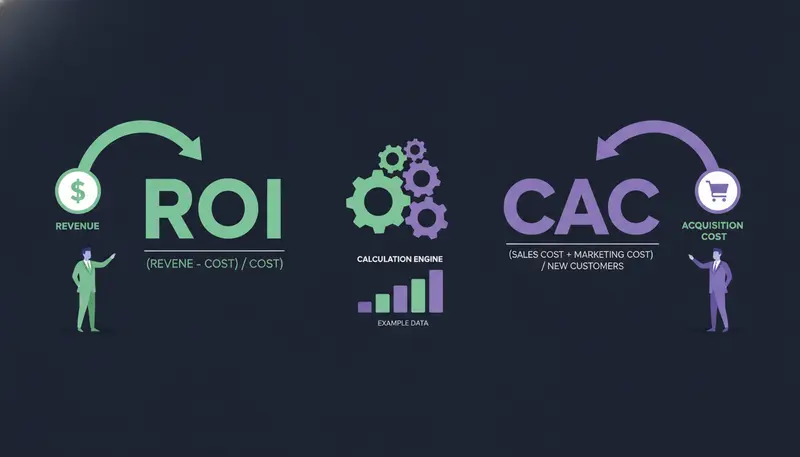
Outbound CAC = (Software + Domain and inbox costs + Data credits + SDR or agency labor) ÷ New customers closed
What goes into the cost side
Count every line that exists only because you do outbound. If you would not pay for it without the campaign, it belongs in the total.
What to include in outbound cost
- Software: the outreach platform, plus any separate CRM, calendar or enrichment tool you pay for.
- Domains and inboxes: sending domains, mailboxes and any other accounts you connect to send from.
- Data credits: what you spend finding people and their contact details, including top-ups.
- Per-use costs: anything charged beyond your plan's monthly allowance.
- Labor: the hours of people who review drafts, answer replies and run follow-ups, or the agency retainer.
- A time window that matches the customers you count on the other side of the division.
Pipeline ROI
CAC tells you what a customer costs. ROI tells you what came back for each dollar spent.
Pipeline ROI = (Gross profit from new customers − Total outbound cost) ÷ Total outbound cost
Use gross profit, not revenue. A customer who pays you 1,000 but costs you 600 to serve returned 400.
Here's the catch: sales cycles. A deal that closes in March may come from a message sent in January. Match customers to the batch of prospects they came from, or your ROI will look better or worse than it is.
Sample Outbound Unit Economics Model (1,000 Prospects -> Closed Deals)
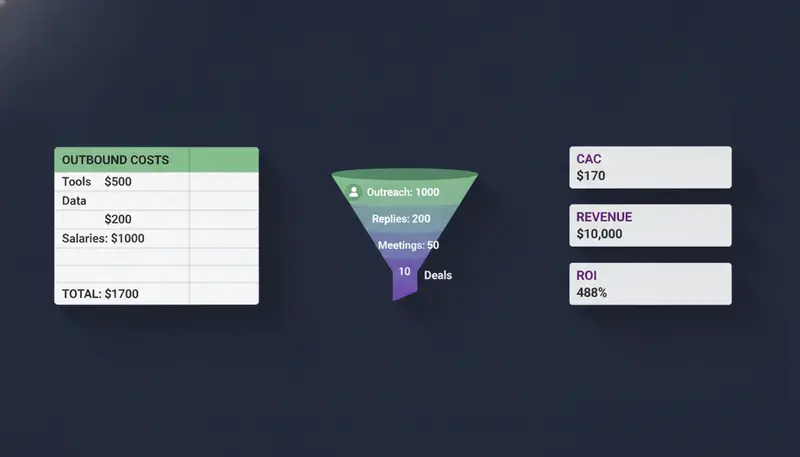
Let's walk one batch of 1,000 prospects from first message to signed customer. Every input below is a placeholder to show the arithmetic.
The funnel
| Stage | Example count |
|---|---|
| Prospects contacted | 1,000 |
| Replies | 40 |
| Interested replies | 12 |
| Meetings held | 6 |
| Customers closed | 2 |
The costs
Now the money spent to run that batch for one month.
| Cost line | Example amount |
|---|---|
| Software (Growth plan, one month) | $249 |
| Domain and inbox costs (placeholder) | $50 |
| Data credits beyond the plan | $0 |
| Labor: 12 hours at $50 | $600 |
| Total | $899 |
The software line is the Growth plan price. That plan includes 1,000 credits a month, and importing a person costs up to 1 credit, so a batch this size can sit inside the allowance. Check your own usage rather than assuming.
The result
- CAC: $899 ÷ 2 customers = $449.50
- Cost per meeting held: $899 ÷ 6 ≈ $150
- Cost per interested reply: $899 ÷ 12 ≈ $75
The stage costs help you find the leak. If cost per interested reply looks fine but cost per customer is high, the problem sits after the reply, not in the outreach.
LTV and Payback: Is That CAC Good Enough?
CAC alone means little. $449.50 is cheap for a customer worth $50,000 and ruinous for one worth $300. So compare it with lifetime value.
LTV = Monthly revenue per customer × Gross margin × Months a customer stays
Say a customer pays $300 a month, your gross margin is 75% and they stay 12 months. LTV is $2,700. Against a CAC of $449.50, that is about 6 to 1.
Payback is the other check. Each customer returns $225 a month in gross profit, so $449.50 is repaid in about two months.
For ROI, two customers return $5,400 in gross profit over those 12 months. Subtract the $899 cost and divide by $899, and you get about 500%. That is arithmetic on example inputs, not a forecast.
The next step is where most teams slip. Re-run the same numbers with one closed customer instead of two. CAC doubles to $899 and the ratio drops to about 3 to 1, from the same campaign. Judge outbound across several batches.
| CAC | Pipeline ROI | |
|---|---|---|
| Question it answers | What does one new customer cost? | What came back for each dollar spent? |
| Formula | Total outbound cost ÷ customers closed | (Gross profit − cost) ÷ cost |
| Needs margin or LTV? | Only to judge the result | Yes, gross profit is built in |
| Example result | $449.50 | About 500% |
| Best used for | Comparing channels and setting budgets | Deciding whether to spend more |
Where the Software and Data Costs Come From
The fixed lines are the easiest to pin down because they are on a price list. ZOROSDR plans are billed monthly in US dollars and every plan has every feature. They differ in seats, sending accounts and monthly allowances, and the built-in CRM is included at no extra cost, so you may not need a separate CRM line. See the pricing for every limit.
Credits pay for finding people (up to 1 credit for each person you import, with their work email), mobile numbers (5 credits) and AI-written messages beyond your plan's allowance (2 credits each). For a closer look at this line, read what it costs to find B2B leads with emails.
Domains and mailboxes are separate. Messages go out through your own connected accounts, and each mailbox, LinkedIn account, WhatsApp or Instagram account, and calling or SMS number counts as a sending account. Add what you pay for them to your total.
Monthly price in US dollars
Choose a plan by the seats and sending accounts you need, not by price alone. Starter is for a founder or single rep, Growth for a team running several sequences, and Agency for agencies running outreach for clients.
How to Calculate Cold Outbound ROI and Customer Acquisition Cost (CAC) for Your Own Campaign
Here is the whole method in order. Do it once on paper, then repeat it each month.
- 1Pick one batch and one windowchoose prospects first contacted in a set period, and decide how long you will wait before counting closed deals.
- 2Add up every costsoftware, domains and inboxes, data credits, per-use charges and labor, using the checklist above.
- 3Count customers from that batchonly include customers who came from this outreach, not people already in conversation.
- 4Divide to get CACtotal cost ÷ customers closed, then work out cost per interested reply and per meeting too.
- 5Work out LTV and paybackmonthly revenue × gross margin × months, then how many months of gross profit repay CAC.
- 6Compare batchesrepeat the exercise and judge the trend, not a single month.
You need clean counts to do this. The built-in CRM tracks your pipeline, deals and companies, and analytics shows people reached, engaged and meetings booked by sequence and channel. Every reply is also sorted as interested, a question, an objection, not now or stop, which makes the interested-reply count easy to pull.
How to Lower Outbound CAC Without Cutting Corners
There are three levers: fewer wasted sends, less labor per customer, and better handling of the replies you do get. None of them guarantees a result, but each one shows up in your formula.
Target better first
A wasted send costs the same as a good one. Tightening your ideal customer profile for outbound is usually the cheapest change you can make.
ZOROSDR has two prospect finders for this. The Lookalike Prospect Finder looks for more companies and people like your best customers. The High-Intent Leads Finder looks for people at companies in a buying moment.
Spend labor where it counts
An AI SDR does not remove labor from the formula. In ZOROSDR every first message lands in your inbox as a draft, and a person approves, edits or skips it. Replies to leads always wait for a person too. The hours change shape: you review and answer in one inbox instead of writing every message from scratch.
Sequences also stop for a lead as soon as they reply, opt out, book a meeting or move to a closing stage, so you stop paying for follow-ups nobody wants. If you are weighing this against hiring, read AI SDR vs human SDR: ROI, ramp time and cost per meeting.
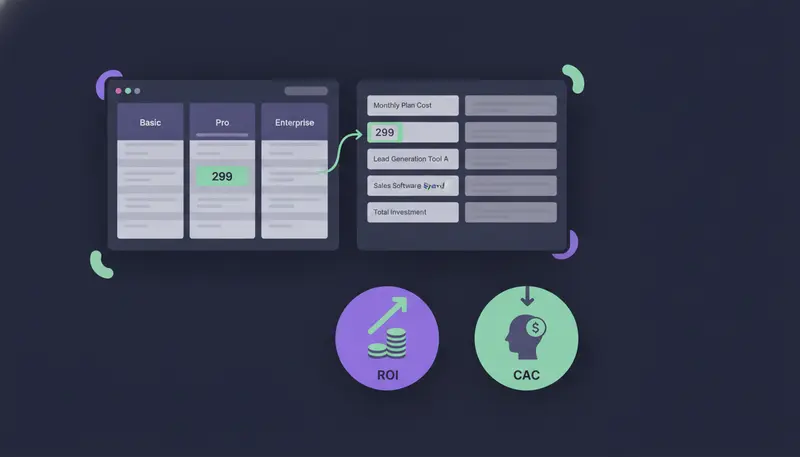
Levers to review each month
- Is every prospect a close match for your best customers?
- Are credits going to people you actually contact?
- How many hours did approving and replying take?
- Which interested replies never became meetings?
- Which sending accounts and channels produced customers, and which only produced cost?
- Did you compare this batch with the last one before changing the plan?
Frequently asked questions
What is a good LTV to CAC ratio for cold outbound?
There is no single right number. It depends on your gross margin and how long you can wait for payback. Compare outbound against your other channels, and check that CAC is repaid in a time your cash flow can carry.
Should I include SDR salary or agency fees in CAC?
Yes. Include the share of salary and time spent on outbound, or the full agency retainer. Leaving labor out understates CAC and makes outbound look cheaper than it is.
How long should I wait before trusting my CAC?
Wait until the sales cycle for that batch has played out. Then repeat across several batches, because with few closed deals a single customer more or less changes the figure a lot.
How do agencies calculate outbound CAC for each client?
Use the same formula for each client's workspace. On the Agency plan ($599 a month), each client gets their own workspace, 3 are included and more cost $39 a month each. Add the agency hours spent on that client.
Summary
Outbound CAC is total software, domain and inbox costs, data credits and labor divided by new customers closed. Judge it against LTV, payback time and gross-profit ROI, and measure over several batches rather than one.
The quickest way to get real inputs is to run a small batch. Start the 14-day free trial and fill in the formula with your own numbers.